Indigo Indigo Exhibition
In June, Pili presented Indigo Indigo, an exhibition held in Paris exploring the dialogue between traditional plant-based indigo and Pili’s bio-based innovation. Through this project, we set out to highlight a timeless pigment, one that humanity has cultivated, transformed, and revered across cultures for millennia.
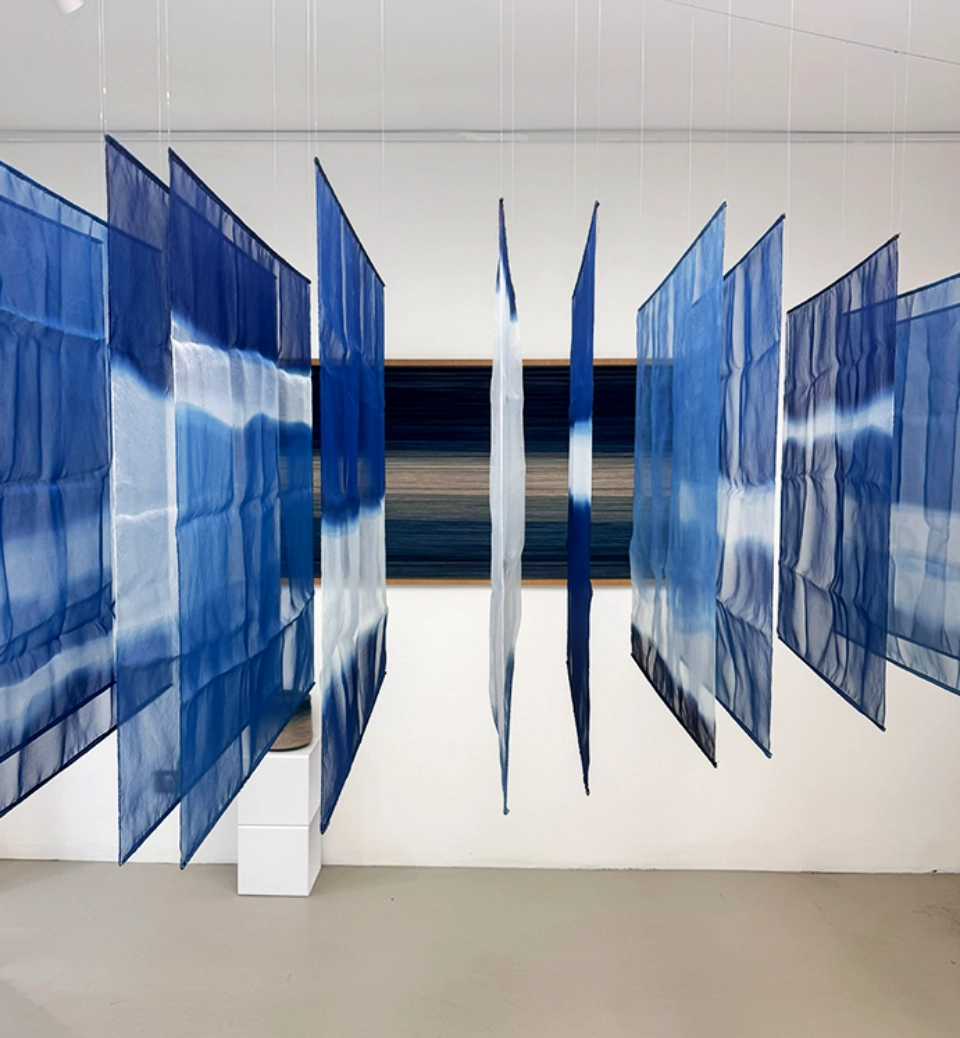
All roads lead to indigo.
This color has been with humanity since the dawn of time, constantly reinventing itself through every possible pathway: plants, fossils, and now bacteria. Across continents and centuries, people have sought to unravel the mystery of this deep blue.
The first chapter of this story began thousands of years ago with plants. A slow, meticulous chemistry took shape through fermentation, oxidation, and a precise choreography of gestures that bring blue out of green.
The second chapter emerged in the late 19th century with petrochemistry. Synthetic indigo made it possible to produce the same molecule at an unprecedented scale and cost, at least economically, as the planet pays a higher price for fossil fuels. With the explosion of blue jeans, indigo spread across the world, along with its pollution.
But indigo’s story does not end there. The 21st century marks its renewal. In a third chapter led by Pili, indigo reconnects with the living world. It is now produced by invisible yet powerful agents: bacteria. Like the first chapter, this process relies on fermentation, which humanity has mastered for thousands of years. Its strength, however, lies in its capacity for large-scale production and its low carbon footprint.
While it breaks away from petrochemistry, this bio-based indigo shares a deep lineage with plant-based indigo. Both arise from a dialogue between humans, plants, and microorganisms. Plant indigo depends on bacteria, just as Pili’s indigo depends on plant biomass. These are therefore two colors imbued with life, whereas petrochemical indigo derives its power from inert, fossil matter.
This is the invisible continuity that the exhibition indigo indigo seeks to reveal. The artworks presented here are exploring harmonies and variations between these two indigos, both celebrating the return of a color to the cycle of life. This dialogue bridges two generations refusing to sever the thread of blue: one is rooted in time and the wisdom of ancestral knowledge; the other embodies the momentum of a new alchemy with the living world.
Artworks

Horizon

Dialogues

Passage

Diptych

Parcels
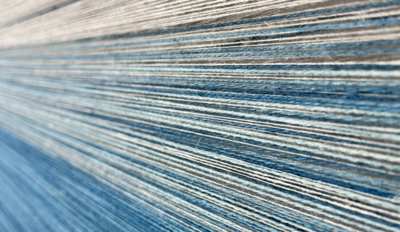


- Horizon
The exhibition opens with this landscape, a window onto a world that is both timeless and yet to come. Sea and sky at dusk unfold in a full spectrum of blue, all derived from a single molecule: indigo, expressed in shifting depths and tones. The spool placed below draws out the thread of the story, echoing a deeply human impulse, to recreate what we see and weave reality into our own forms.
- Dialogues
This is the first encounter between plant-based indigo and Pili Eco-Indigo. The silk square becomes a shared space: part playground, part meeting ground, part conversation. Each scarf expresses a dialogue of varying intensity. The two blues seem magnetically drawn toward one another, converging at the center. When worn, the scarf reveals these two shades on each side of the body. Tying it around the neck extends the dialogue: wearing it becomes a gesture that embodies this connection.
- Passage
In Japan, a noren marks a threshold, a passage between spaces, between worlds. Here, it becomes a transition from one blue to another. The two panels stand as parallel pillars of a shared story. Their separation highlights their differences, while the seam that joins them at the top speaks to what they have in common. The white circle evokes unity: two half-moons completed into a full moon by the eye. Passing through the noren is a way of stepping into both narratives at once.
- Diptych
At first glance, the same blue on both sides. Yet one comes from plants, the other from bacteria. Each holds the secret of this deep blue. It is up to us to tell them apart.
- Parcels
Like an aerial map, this work reflects the amount of indigo produced from a given piece of land. Producing one kilogram of Pili Eco-Indigo requires twenty times less farmland than plant-based indigo. The blue jean, an icon of global fashion and indigo dyeing, with 250,000 pieces already produced by Pili in collaboration with Citizen of Humanity, is here deconstructed into fabric plots. To visualize this ratio, only the back pocket is dyed with plant-based indigo, while the rest is dyed with Pili Eco-Indigo.
Exhibition initiated and developed by Pili as part of the European project Colour4CRAFTS
Concept, design & texts: Marie-Sarah Adenis (Pili)
Conception & dyeing: Couleur Garance, France
Bio-based indigo: Eco-Indigo Pili
Plant-based indigo: Persicaria tinctoria (Champs des Couleurs, France)
Pili team: Julie Lacondemine, Pauline Rullière, Pierre-Yves Bolle, Jérémie Blache
Couleur Garance team: Harumi Sugiura, Lise Camoin Anouk Zibaut, Amandine Yvan
Funding: European Union | This exhibition acknowledges the financial support provided for the research presented here, under the European “Research and Innovation Action” program for the Colour4CRAFTS project, No. 101094809